Reading CPython Source (1): Types and Objects
Originally published in Chinese on 2021-03-14; this English edition preserves the original scope and technical context.
Python is an interpreted, dynamically typed, multi-paradigm programming language. When we download and install a version of Python from python.org, we are actually running the C language-compiled CPython. In addition to CPython’s runtime, there are also Jython, PyPy, Cython, and others; within the source code of CPython, there are a series of libraries, components, and tools.
$ git clone https://github.com/python/cpython
$ tree -d -L 2 .
.
`-- cpython
|-- Doc			# Document
    |-- Grammar
|-- Include 	# C Header
|-- Lib			# Python Library
|-- Mac			# For macOS Build
|-- Misc		# Misc
|-- Modules		# C Library
|-- Objects 	# Core types and definitions of the object model
|-- PC			# For Windows Build
|-- PCbuild 	# For older versions of Windows Build
|-- Parser		# Python Parser Source Code
|-- Programs	# Python Executables and other
|-- Python		# CPython Compiler Source Code
|-- Tools		# Build Tools
    `-- m4

16 directories
Object Model
Python is an object-oriented language, and we can use the type() function in Python to view the class of an object:
>>> type(1)
<class 'int'>
>>> type(True)
<class 'bool'>
The integer object and boolean value object are of type <class 'int'> and <class 'bool'>, respectively.
While in Python, whether integers, boolean values, or basic data types, even custom classes, are all objects:
class Foo:
    pass

print(type(int))
print(type(Foo))
<class 'type'>
<class 'type'>
One can see that the types of int and the custom class Foo are both <class 'type'>, instances of the type class; the type type is specifically used for defining types, also known as meta-types; in fact, the type itself is an object, and its class is also type.
>>> type(type)
<class 'type'>
Simultaneously, all types in Python, whether int, type, or a custom class Foo, inherit from a base class called object. object is the endpoint of the inheritance chain:
inttypeFoo(custom class)
All of these types inherit from object, which serves as the root of the inheritance hierarchy.
>>> int.__base__
<class 'object'>
>>> type.__base__
<class 'object'>
>>> print(Foo.__base__)
<class 'object'>
>>> print(object.__base__)
None
While the object base class is also an object of type type:
>>> type(object)
<class 'type'>
Above relationship can be expressed in the diagram as follows:
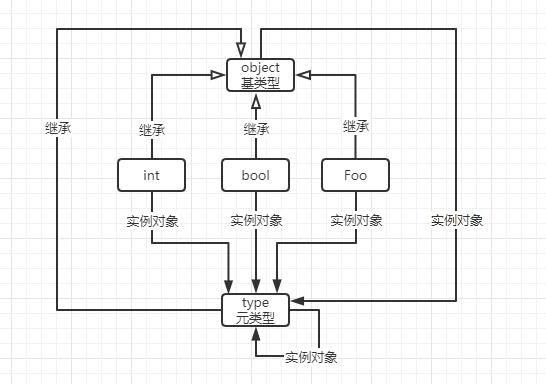
One can see that all types of base classes are object, and all types of types are type. This is the object model (object model) of Python, the content included in the source code under the Objects/ directory.
Core Types and Objects
Although Python has many types at the syntax level (including int, type, Foo, etc.), they are actually struct objects at the source (C language) level.
2.1 Object
PyObject
In Python, all types are extended by the PyObject structure, which contains the following members:
Py_ssize_t ob_refcntused to save the reference count of the object;PyTypeObject *ob_typepoints to the type object of the object, used to identify the type of the object and store the metadata of the type;_PyObject_HEAD_EXTRAmacro represents two pointers toPyObject*, used to link all objects on the heap via a bidirectional linked list. These are only constructed when thePy_TRACE_REFSmacro is enabled for debugging purposes.
// Include/object.h

/* Define pointers to support a doubly-linked list of all live heap objects. */
#define _PyObject_HEAD_EXTRA            \
    struct _object *_ob_next;           \
    struct _object *_ob_prev;

/* Nothing is actually declared to be a PyObject, but every pointer to
 * a Python object can be cast to a PyObject*.  This is inheritance built
 * by hand.  Similarly every pointer to a variable-size Python object can,
 * in addition, be cast to PyVarObject*.
 */
typedef struct _object {
   _PyObject_HEAD_EXTRA	// Doubly linked list to track all objects on the heap, useful when Py_TRACE_REFS macro is enabled
    Py_ssize_t ob_refcnt;	// Reference count to facilitate garbage collection
    PyTypeObject *ob_type;	// Pointer to the type object of the current object, used to query the object's type
} PyObject;
PyVarObject
In Python, there exists the mutable-length PyVarObject object, which consists of a PyObject object and a variable ob_size that stores the length of the variable portion (number of elements).
typedef struct {
    PyObject ob_base;
    Py_ssize_t ob_size; /* Number of items in variable part */
} PyVarObject;
PyObject and PyVarObject are typically included as headers in a variable structure, and the choice between the two depends on whether the size of the variable is fixed:
// Include/object.h
/* PyObject_HEAD defines the initial segment of every PyObject. */
#define PyObject_HEAD          PyObject ob_base;

/* PyObject_VAR_HEAD defines the initial segment of all variable-size
 * container objects.  These end with a declaration of an array with 1
 * element, but enough space is malloc'ed so that the array actually
 * has room for ob_size elements.  Note that ob_size is an element count,
 * not necessarily a byte count.
 */
#define PyObject_VAR_HEAD      PyVarObject ob_base;
Python’s typical variable-length object is the list, which is similar to std::vector. The list object has three member variables, including:
- The basic variable-length object
PyVarObject ob_base, whereob_base.ob_sizerepresents the current number of elements in the list; - Pointer to the dynamic array
PyObject **ob_item; - Current capacity of the dynamic array
Py_ssize_t allocated:
// Inlucde/cpython/listobject.h

typedef struct {
    PyObject_VAR_HEAD
    /* Vector of pointers to list elements.  list[0] is ob_item[0], etc. */
    PyObject **ob_item;

    /* ob_item contains space for 'allocated' elements.  The number
     * currently in use is ob_size.
     * Invariants:
     *     0 <= ob_size <= allocated
     *     len(list) == ob_size
     *     ob_item == NULL implies ob_size == allocated == 0
     * list.sort() temporarily sets allocated to -1 to detect mutations.
     *
     * Items must normally not be NULL, except during construction when
     * the list is not yet visible outside the function that builds it.
     */
    Py_ssize_t allocated;
} PyListObject;
2.2 Types
PyTypeObject
In PyObject, PyTypeObject *ob_type points to the object’s type—the representation of a class in Python. PyTypeObject determines the type of a PyObject and also carries extensive metadata.
PyObject_VAR_HEADindicates thatPyTypeObjectitself is a variable-length object;const char *tp_namerepresents the type’s name;struct _typeobject *tp_baseis a pointer to the base type, storing inheritance information;Py_ssize_t tp_basicsize, tp_itemsizerepresents the amount of memory allocated for creating an instance object;setattrfunc tp_setattrsets values,getattrfunc tp_getattrgets values,destructor tp_deallocis the destructor, andhashfunc tp_hashare function pointers indicating the standard operations supported by this type.
// Include/object.h

/* PyTypeObject structure is defined in cpython/object.h.
   In Py_LIMITED_API, PyTypeObject is an opaque structure. */
typedef struct _typeobject PyTypeObject;

// Include/cpython/object.h
struct _typeobject {
PyObject_VAR_HEAD // PyVarObject ob_base;
    const char *tp_name; /* For printing, in format "<module>.<name>" */
    Py_ssize_t tp_basicsize, tp_itemsize; /* For allocation */

    /* Methods to implement standard operations */

    destructor tp_dealloc;
    Py_ssize_t tp_vectorcall_offset;
    getattrfunc tp_getattr;
    setattrfunc tp_setattr;
    PyAsyncMethods *tp_as_async; /* formerly known as tp_compare (Python 2)
                                    or tp_reserved (Python 3) */

    // Strong reference on a heap type, borrowed reference on a static type
    struct _typeobject *tp_base;

    /* More standard operations (here for binary compatibility) */
    // ...
};
In Python, each type object is globally unique. They exist as global variables in the source code, such as int type:
// Objects/longobject.c
PyTypeObject PyLong_Type = {
    PyVarObject_HEAD_INIT(&PyType_Type, 0)
    "int",                                      /* tp_name */
    offsetof(PyLongObject, ob_digit),           /* tp_basicsize */
    sizeof(digit),                              /* tp_itemsize */
    0,                                          /* tp_dealloc */
    0,                                          /* tp_vectorcall_offset */
    0,                                          /* tp_getattr */
    0,                                          /* tp_setattr */
    0,                                          /* tp_as_async */
    long_to_decimal_string,                     /* tp_repr */
    &long_as_number,                            /* tp_as_number */
    // ...
};
PyVarObject_HEAD_INIT macro initializes PyVarObject members ob_refcnt, ob_type, and ob_size:
#define PyObject_HEAD_INIT(type)        \
    { 1, type },

#define PyVarObject_HEAD_INIT(type, size)       \
    { PyObject_HEAD_INIT(type) size },
One can see that ob_type is initialized to &PyType_Type in PyLong_Type. This is the type of type used for defining type objects, or alternatively, the type of types or base types.
PyType_Type
Previously, we learned that the type of the type object is a class, and thus the type object itself is also a class object, which has a pointer to its type object PyTypeObject *ob_type; for the type object itself, its type object is based on a class object called PyType_Type (i.e., the “meta-type”).
// Objects/typeobject.c
PyTypeObject PyType_Type = {
   PyVarObject_HEAD_INIT(&PyType_Type, 0)		// PyType_Type initializes the pointer to itself during initialization, constructing a PyVarObject of type, where ob_base->ob_type = &PyType_Type, as per Appendix 1
    "type",                                     /* tp_name */
    sizeof(PyHeapTypeObject),                   /* tp_basicsize */
    sizeof(PyMemberDef),                        /* tp_itemsize */
    (destructor)type_dealloc,                   /* tp_dealloc */
    offsetof(PyTypeObject, tp_vectorcall),      /* tp_vectorcall_offset */
    // ...
};
In Python, type objects are defined under the Objects/ directory. For example, the bool type:
// Objects/boolobject.c

/* The type object for bool.  Note that this cannot be subclassed! */

PyTypeObject PyBool_Type = {
PyVarObject_HEAD_INIT(&PyType_Type, 0)	// PyType_Type, ob_base->ob_type = &PyType_Type
    "bool",										// tp_name = "bool"
    sizeof(struct _longobject),					/* tp_basicsize */
    0,											/* tp_itemsize */
    0,                                          /* tp_dealloc */
    0,                                          /* tp_vectorcall_offset */
    0,                                          /* tp_getattr */
    0,                                          /* tp_setattr */
    0,                                          /* tp_as_async */
    bool_repr,                                  /* tp_repr */
    &bool_as_number,                            /* tp_as_number */
    // ...
    0,                                          /* tp_base */
    // ...
};
In Python, both built-in types (such as int, bool, etc.) and user-defined types (such as Foo) are constructed through the PyTypeObject structure, and they always satisfy ob_base->ob_type = &PyType_Type.
Previously mentioned, tp_base is a pointer to the base class, storing inheritance information for a type. However, when defining PyBool_Type, it can be seen that tp_base is set to PyBaseObject_Type in the PyType_Ready function, even though it is explicitly 0 in PyBool_Type definition:
// Objects/typeobject.c

int
PyType_Ready(PyTypeObject *type)
{
    PyTypeObject *base;
    // ...
	/* Initialize tp_base (defaults to BaseObject unless that's us) */
    base = type->tp_base;
    if (base == NULL && type != &PyBaseObject_Type) {
        base = &PyBaseObject_Type;
        if (type->tp_flags & Py_TPFLAGS_HEAPTYPE) {
            type->tp_base = (PyTypeObject*)Py_NewRef((PyObject*)base);
        }
        else {
            type->tp_base = base;
        }
    }
    // ...
}
Here, PyTypeObject *base is assigned to PyBaseObject_Type, which is the base type mentioned earlier.
PyBaseObject_Type
PyBaseObject_Type is defined in the typeobject.c file.
// Objects/typeobject.c
PyTypeObject PyBaseObject_Type = {
PyVarObject_HEAD_INIT(&PyType_Type, 0)	// PyType_Type, ob_base->ob_type = &PyType_Type
    "object",                                   /* tp_name */
    sizeof(PyObject),                           /* tp_basicsize */
    0,                                          /* tp_itemsize */
    object_dealloc,                             /* tp_dealloc */
    // ...
    object_repr,                                /* tp_repr */
	// ...
    0,                                          /* tp_base */
    // ...
};
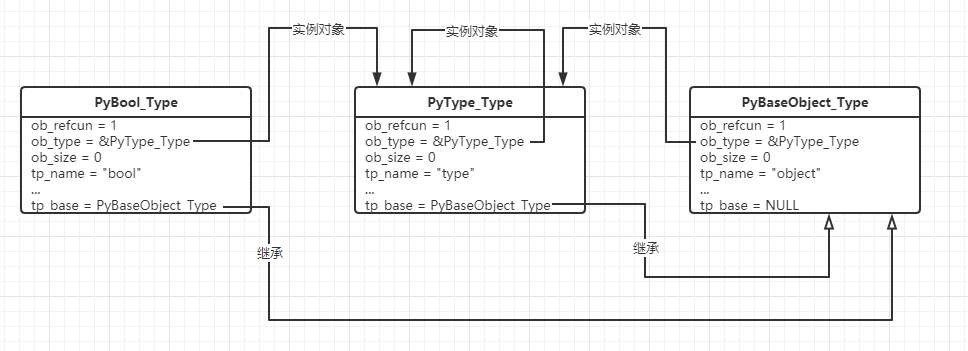
One can see that both PyBool_Type, PyType_Type, and PyBaseObject_Type share two common points:
They are defined with the same type of PyVarObject_HEAD_INIT(&PyType_Type, 0), thus their types are PyTypeObject;
tp_base pointer is initialized to NULL when they point to the base;
Different places are, when assigning their base class pointer tp_base using the PyType_Ready function, only PyBaseObject_Type.tp_base is not assigned, while the others are assigned to PyBaseObject_Type. This confirms that PyBaseObject_Type is the end of the inheritance chain.
We can organize the above relationships into a graph:
Appendix
1 PyType_Type Constructor
struct Bar;

struct Foo
{
	Bar* p_b;
	int ref_count;
};

struct Bar
{
	Foo f;
	const char* name;
};

Bar b
{
	Foo{ &b, 1 },
	"ClassBar"
};

int main()
{
	printf("%s\n", b.f.p_b->name);
	return 0;
}
$ ./test
ClassBar